Wednesday, December 29, 2010

The Abyssinian

The Abyssinian by Jean-Christophe Rufin.  Trans from French by Willard Wood.


Big, plot-driven, historical novel, set in Cairo, Versailles and Abyssinia around 1699, during the reign of Louis XIV.  Follows the adventures of Jean-Baptiste Poncet, an accomplished French apothecary and wanderer who has found a refuge in Cairo, and falls in love with Alix, the French Consul's daughter.  


The plot is all political intrigue, quests and adventures, with the romance running as a thin thread of motivation through it.  The period details seem very convincingly authentic and thoroughly researched.  The plot moves quickly, much of the writing is enjoyable, and one need not dwell too much on psychological detail.  The best part is the middle section, where the apothecary travels to Abyssinia.  Towards the end I got tired of the endless machinations and thought the last third of the novel could have been pruned heavily; at ~450 pages its a longish read.  The details of the ending are not predictable but the essence is.


Reminds me of the adventure novels I enjoyed when young.  A lot of "Beau Geste" and H. Rider Haggard ("King Solomon's Mines").  A white, low-born adventurer who is despised by polite society but is fiercely independent, and subscribes to a very modern code of integrity, embarks on a dangerous quest in hostile, foreign lands, and eventually wins by his wits, courage and drive.  He has a trusty, loyal, idiosyncratic companion who serves as an earthy, moral touch-stone and also occasionally provides comic relief.  The natives are lazy, corrupt, conniving buffoons, or some combination thereof -- with the sole exception of the Supreme Native (in this case, the King of Abyssinia), who turns out to be remarkably intelligent, humane, wise and perceptive, and in fact the only native who can be seen as worthy of the hero's respect.  The white courtiers and political elites are also corrupt and conniving, and in some cases buffoons, but still are described with some (minimal) depth.  The country is an exotic backdrop, its seasons and colors and smells described in excellent detail but ultimately seen through a tourist's eyes.  In all this it starts to resemble a British Raj novel -- and this French Raj evocation may explain why the book won the Prix Goncourt and other French prizes.  (In fact the cover of the book gives a hint of this).


The romance is the ickiest part of the novel.  The descriptions of Poncet's and Alix's (mostly clandestine) meetings read as if they were taken straight from a Harlequin romance: the lovers gaze into each other's eyes, feel gusts of swooning ecstasy as they linger over treasured kisses etc etc ad nauseum.  I wonder if this was thrown in to make the book more appealing to a female audience.  Alix matures from being an innocent wallflower literally trapped in the Consul's walled garden to a pistol-packing adventurer herself, although her adventuring is solely to escape to her beloved. I wonder if that was thrown in to assuage any guilt the female audience may have for enjoying the Harlequin romance. 


What is interesting is that given all this background, the author is actually a very admirable personage: one of the founders of Doctors Without Borders (which I respect immensely) and also himself a doctor who has led missions in Africa.  He was commissioned by the French government to write what became an important report onthe origins and dangers of racism and anti-Semitism in French society.  Yet the novel bears all the hallmarks of Orientalism and easy generalizations, while I would have expected a more nuanced, insightful, and truly modern treatment. 


In short, somewhat enjoyable, rather shallow, marginally racist and sexist (although unwittingly so).   


2*
Dec 2010 

Wednesday, November 24, 2010

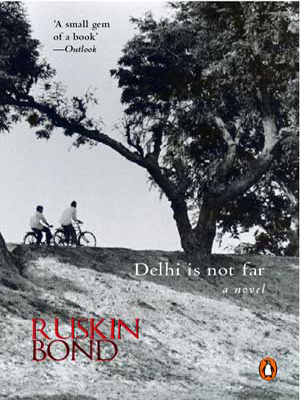
Delhi is not far

Delhi is Not Far, Ruskin Bond. 

A quiet, gentle novella, with all the classic charm and deceptive simplicity of vintage Ruskin Bond.  In fact, it *is* vintage Ruskin Bond, the revision of a story he wrote in the 1960s when he moved from Dehradun to Delhi, before he became disillusioned with big-city life and moved back.

What is startling, and different from classic Ruskin Bond, is the frank depiction of a three-way love story between two young men and a young woman.

Elsewhere in Bond stories you catch the hints of homoerotic love. Here it is one of the main themes.  The narrator is Arun, a young, frustrated literary writer who churns out bad detective novels to earn a meagre existence in the small town of Pipalnagar; he meets and falls in love with another young man, Suraj, a walking street vendor of perfumes and knick-knacks.  They both befriend, make love to, and have deep affection for Kamla, a young prostitute married to a much older man.  Arun's growing love for Suraj forms a central thread through the story, and the depictions of his love-making with Kamla are brief but powerful.  

The other main theme is the town of Pipalnager, and the Mohalla (roughly, neighborhood) in which Arun lives. He longs to escape, to the wider world of books and ideas and opportunity represented by Delhi, but is trapped by his melancholy, his fear, his inertia.  The characters of Pipalnager -- the barber, the junkyard man, the beggars -- are so affectionately, so compassionately sketched that one suspends disdain at them being somewhat sterotypical.

These characters form the basis of small-town life, where there is no anonymity like the big city, but no privacy either; where these friendships and associations ease daily living but offer no safety net either; where dreams are hobbled by lack of imagination and action by lack of passion.  Bond captures these in quick, deft strokes, convincingly and with quiet humor.  It is clear none of the other characters will leave Pipalnager, even though Delhi is not far; will Arun and his two loves?

There is no highlighted irony here, no drama, no explicit struggle with complex ideas or conflicts.  There is mostly clean, lyrical, simple writing that comes perilously close to sheer sentimentality but does earn its rich prose:
  
     "Hills of green and grey rock, misty at dawn, hazy at noon, molten at sunset; where fierce fresh torrents rush to the valleys below.
     A quiet land of fields and ponds, shaded by ancient trees and ringed with palms, where sacred rivers are touched with temples; where temples are touched by the southern seas.
     This is the real land, the land I should write about. ..."

The attachment, the reverence, the love for the land, for his soil, is unabashed and actually quite powerful.  I was prepared to be warmed but left without substance, and I think the book is more than that.

3.5*
(Nov 2010)

Thursday, November 18, 2010

All That Heaven Allows

All That Heaven Allows.  Dir: Douglas Sirk, 1955.  Jane Wyman, Rock Hudson.


December-May romance between a wealthy widow, Carrie, and her tree service man, stirs up a small town's cattiness, conformity and cruelty.  Jane Wyman gives a convincing, nuanced performance.  Hudson is mostly just a pretty face with muscles, as Carrie's son Ned says.  The townspeople ask, in a sense, "What does she see in  him?"; Jane Wyman's acting is so fine that it almost answers my question: "What does he see in her?".

Lots of saccharine Hallmark card shots (old mill by the river, deer framed in picture window as snow falls, etc).  Some dialogue that seems hilarious given that we now know Hudson was gay.  For example Carrie asks, "So you want me to be a man?"; he answers, "Only in that one way".  (However, he was out in Hollywood, so maybe this was just an inside joke by the fimmakers.)

Universal made this film apparently to cash in on the popularity of Magnificent Obsession, another Wyman-Hudson December-May romance.  Funny that this obvious soap opera, where superficial social commentary on class and age is just an excuse for romantic drama, is now considered one of Sirk's finest films and is gathering critical acclaim.

2.5*
Nov 2010